
HDB Resale Prices Fall for a Third Consecutive Quarter: Is the Market Cooling?
Singapore’s HDB resale price index fell for a third consecutive quarter in Q3 2026, declining 0.2% to 202.4. But with resale transactions remaining broadly stable and running 5.2% above the same period last year, the market may be moderating rather than weakening sharply. Here is what the latest figures mean for HDB buyers and sellers, how upcoming flat supply could influence the market, and what to consider before making your next property decision.
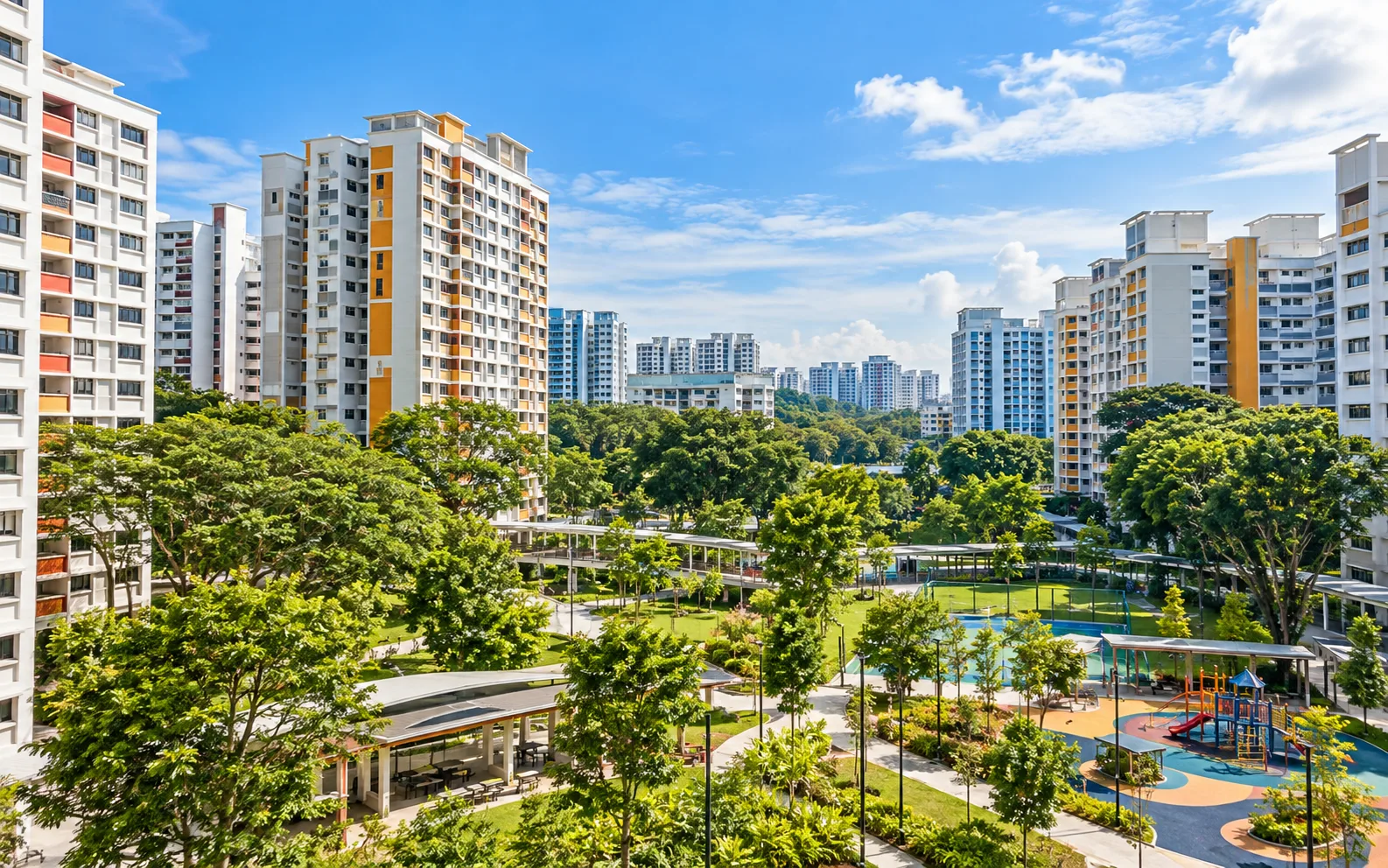
Singapore’s HDB resale market recorded another small price decline in the third quarter of 2026, extending a trend that began earlier in the year.
According to the Housing & Development Board’s (HDB) flash estimate released on 30 September 2026, the HDB Resale Price Index fell 0.2% quarter-on-quarter to 202.4 in Q3. This followed declines of 0.1% in Q1 and 0.3% in Q2.
Three consecutive quarterly declines naturally raise questions for homeowners and prospective buyers. Is the resale market finally cooling after years of strong price growth? Should buyers wait for lower prices? And should sellers reconsider their expectations?
The answer is more nuanced than the headline suggests.
HDB reported 7,528 resale transactions as of 29 September 2026, 5.2% more than the 7,157 transactions recorded over the corresponding period in 2025. HDB described transaction activity as broadly stable.
In other words, the price index has eased, but transactions have not dried up. This is an important distinction when assessing the health of the market.
The figures discussed in this article are based on HDB’s flash estimate and may differ from the final Q3 statistics. They should be treated as an early indication of market conditions rather than a definitive forecast of future prices.
What Happened to HDB Resale Prices in Q3 2026?
The HDB Resale Price Index, or RPI, tracks overall price movements in the public housing resale market. It is a useful indicator of the market’s general direction, but it does not tell buyers exactly what a particular flat is worth.
HDB’s flash estimate showed the following quarterly movements:
Quarter | Resale Price Index | Quarterly change |
|---|---|---|
Q3 2025 | 203.7 | +0.4% |
Q4 2025 | 203.6 | 0.0% |
Q1 2026 | 203.4 | −0.1% |
Q2 2026 | 202.8 | −0.3% |
Q3 2026 | 202.4 | −0.2% |
Source: HDB’s published resale statistics and Q3 2026 flash estimate.
The index has moved down from 203.6 in Q4 2025 to 202.4 in Q3 2026. This represents a gradual easing in the overall index rather than a sudden collapse.
Three points stand out.
First, the decline has continued for three quarters. This is a meaningful change from a market in which resale prices were consistently increasing.
Second, the quarterly declines have been relatively small. The latest 0.2% fall does not, by itself, establish that prices across every town, flat type or individual block have declined by the same amount.
Third, the index remains well above its historical base value of 100, which represents Q1 2009. That comparison provides long-term context, but it should not be interpreted as a measure of whether current flats are affordable or fairly priced.
The index is best used alongside recent transactions, local market conditions and the characteristics of the flat being considered.
Is Singapore’s HDB Resale Market Really Cooling?
The latest figures support the view that overall resale price growth has moderated. However, the term “cooling” needs to be understood carefully.
A cooling market does not necessarily mean that prices are falling sharply, that sellers cannot find buyers or that every flat will become cheaper.
It can instead mean that the pace of price growth has slowed, buyers are becoming more selective, and sellers may need to pay closer attention to market evidence when setting their asking prices.
Prices Have Declined for Three Consecutive Quarters
The most direct evidence of moderation is the series of quarterly declines recorded in 2026.
The RPI fell by 0.1% in Q1, 0.3% in Q2 and 0.2% in Q3. The direction has been consistent, although the size of each decline has been modest.
This pattern suggests that the broad upward momentum seen in earlier periods has eased. It does not establish how long the trend will continue.
Property prices are affected by multiple factors, including household finances, housing supply, interest rates, buyer eligibility, flat characteristics and the availability of alternatives.
Buyers should therefore avoid treating three consecutive quarterly declines as a guarantee that prices will keep falling.
Resale Transactions Have Remained Broadly Stable
The transaction figures provide an important counterpoint to the falling index.
HDB recorded 7,528 resale transactions in Q3 as of 29 September 2026, compared with 7,157 over the same period in 2025. That represents a 5.2% year-on-year increase.
This does not mean that demand is equally strong in every town or price range. It does, however, show that the market continued to record transactions while the overall price index eased.
A market can experience lower prices alongside stable transaction activity. Buyers may continue purchasing flats that meet their needs while negotiating more carefully or choosing different locations and flat types.
For sellers, this means there may still be buyers in the market, but the price and characteristics of the flat matter. For buyers, it means that waiting for a broad price decline does not guarantee that a preferred flat will become available at a lower price.
A National Index Does Not Describe Every Flat
HDB’s RPI measures overall price movements across the resale market. It is not an individual valuation.
Two flats in the same town can attract different prices because of their remaining lease, floor level, orientation, layout, condition, proximity to transport, nearby amenities and other characteristics.
The mix of transactions in a particular quarter can also affect how the overall market is perceived.
For example, if a larger proportion of transactions involves flats with different sizes, locations or remaining leases, the experience of an individual buyer may differ from the headline index.
This is why buyers and sellers should review recent comparable transactions instead of relying on the national percentage change alone.
What Could Be Influencing the HDB Resale Market?
Several developments are relevant to the outlook. However, it is important to distinguish confirmed policy changes and official figures from possible market effects.
1. The Removal of the 15-Month Wait-Out Period
On 28 July 2026, the 15-month wait-out period was removed for private residential property owners and former owners buying eligible non-subsidised HDB resale flats.
The wait-out period had been introduced on 30 September 2022 as a temporary measure to moderate housing demand and prioritise access to public housing for first-time buyers.
Some market observers may have expected the policy change to bring more private property owners into the resale market, potentially affecting demand for certain flats.
However, HDB stated in its Q3 flash estimate that it had not observed a significant increase in the prices or number of resale flats purchased by private property owners and former owners since the change. It also said it would continue monitoring the market.
This is an important distinction. The policy changed, but the official statement does not support a claim that it has already caused a substantial rise in resale prices.
Buyers affected by the policy should check their eligibility and the conditions applicable to their intended purchase directly with HDB before making plans.
2. Upcoming BTO Flat Supply
HDB announced that approximately 7,960 flats are planned for the November 2026 Build-To-Order exercise in Bedok, Geylang, Sembawang, Tengah, Toa Payoh and Yishun. Community Care Apartments will also be offered in Toa Payoh.
A steady supply of new flats gives eligible buyers another option to consider. For some households, a BTO flat may be a suitable alternative to purchasing a resale flat, depending on eligibility, location preferences, expected waiting time and immediate housing needs.
However, the effect on resale demand will vary. A household that needs to move soon may have different priorities from a first-time buyer who can wait for a new flat.
The announcement alone does not prove that upcoming BTO supply has caused the recent resale price declines. Its impact will depend on buyer choices, the locations and types of flats offered, and the timing of actual availability.
3. Interest Rates and Household Affordability
HDB highlighted uncertainty in the macroeconomic outlook, including global and domestic interest rates, and advised households to exercise prudence when purchasing property and taking out mortgage loans.
Borrowing costs are one part of the affordability equation. Buyers also need to consider their income stability, available savings, CPF funds, upfront costs and expected monthly expenses.
A lower flat price may help with the purchase budget, but it does not automatically make every purchase financially comfortable. Likewise, a household that can afford a particular flat today should still consider how its finances might change.
Buyers should compare financing options and test whether the purchase remains manageable under less favourable circumstances.
4. Future Resale Supply
The number of flats entering the resale market can affect the choices available to buyers. HDB noted that a larger number of new flats are expected to enter the resale market after meeting their Minimum Occupation Period over the next few years.
More available flats could give buyers additional choices in some locations. However, supply does not affect every town and flat type in the same way.
The age, location, size and characteristics of the flats entering the market will matter, as will the level of demand from eligible buyers.
It is therefore more useful to assess supply at the local level than to assume that additional resale flats will automatically produce a uniform nationwide price decline.
What Should HDB Buyers Do in This Market?
A market showing modest price declines can create opportunities for buyers, but it does not eliminate the need for careful planning.
The goal should be to identify a suitable flat at a price that makes sense for your circumstances, rather than trying to predict the exact bottom of the market.
1. Start With Your Budget and Eligibility
Before viewing flats, establish what you can realistically afford.
Consider your income, available cash and CPF funds, potential housing grants, loan eligibility, monthly repayment capacity and other financial commitments.
Buyers planning to use an HDB housing loan should review the applicable eligibility requirements. Buyers considering bank financing should compare the terms and repayment implications of available options.
HDB’s Flat Eligibility (HFE) letter provides information about eligibility to buy a new or resale flat, CPF housing grants and HDB housing loan eligibility, including the relevant grant and loan amounts.
Confirm your circumstances and obtain the necessary approvals before committing to a purchase.
2. Compare Recent Transactions
Do not rely exclusively on advertised asking prices. Review recent completed transactions for comparable flats in the same block or nearby streets, where available.
Consider the flat type, floor level, remaining lease, condition and location. A comparison is more useful when the properties share similar characteristics.
HDB provides resale statistics and past transaction information to help buyers understand price movements. Its resale statistics page includes median resale prices by town and flat type for registered resale applications, with notes on how the figures should be interpreted.
You can start with the official HDB Resale Statistics page.
3. Decide Whether You Need a Flat Now
The decision to buy now or wait depends partly on your housing needs.
If you need a home soon, waiting indefinitely for lower prices may not be practical. Renting for longer, moving more than once or postponing family plans may also carry costs.
If your housing arrangements are flexible, you may have more time to compare properties, review upcoming BTO options and assess whether a particular resale flat represents good value.
Neither approach is automatically better. The right choice depends on your eligibility, timeline, financial position and preferred location.
4. Look Beyond the Purchase Price
A flat’s purchase price is only part of its total cost.
Depending on your circumstances, you may need to account for stamp duties, legal fees, renovation, repairs, moving expenses and ongoing maintenance. You should also consider the flat’s remaining lease and how that fits your intended period of ownership.
A lower-priced flat may require substantial renovation or involve compromises that are unsuitable for your household. A more expensive flat may offer practical benefits, but those benefits need to justify the additional financial commitment.
Assess the whole purchase rather than comparing prices in isolation.
5. Consider Your Long-Term Needs
Think about how long you expect to live in the flat and whether it meets your needs over that period.
Consider access to work, public transport, schools, family support, amenities and future household requirements. If you may need to move again, consider the potential resale market for that type of flat, while recognising that future prices cannot be guaranteed.
The best purchase is not necessarily the cheapest one. It is the one that meets your needs and remains financially manageable.
For additional guidance, explore the proposed HDB property guide and resale HDB guide. These destinations should be verified against the live website before publication.
What Should HDB Sellers Do?
Three consecutive quarterly price declines may make some owners concerned about selling at the right time. The latest data, however, does not mean that every seller needs to lower their price immediately.
A sensible approach is to assess the specific property and its competition.
1. Set an Asking Price Based on Evidence
Begin with recent comparable transactions rather than relying solely on previous market highs or the price achieved by a different flat.
Consider the flat’s condition, remaining lease, floor level, layout, location and any features that distinguish it from nearby alternatives.
An asking price should reflect the property's strengths while remaining credible to potential buyers.
An unrealistic price may reduce viewing interest or extend the time required to sell. On the other hand, setting a price without understanding the property's competitive position may result in accepting less than a well-supported strategy could achieve.
2. Review Competing Listings
Buyers often compare several flats before making a decision. Review what else is available in your block, town and preferred buyer price range.
Consider whether competing flats offer a longer remaining lease, a different layout, better condition or other practical advantages.
Remember that an advertised price is not proof of the amount a buyer will ultimately pay. Use completed transactions as part of the assessment.
3. Prepare the Flat for Viewings
A well-presented flat can make it easier for buyers to understand its layout and potential.
Clean the property, address obvious maintenance issues and ensure that photographs accurately represent the home. Decluttering may help buyers assess the space without distraction.
Before investing in major renovations, consider whether the expected benefit justifies the cost. Expensive upgrades do not guarantee an equivalent increase in the selling price.
4. Plan Your Next Housing Move
If you are selling to purchase another property, consider the two transactions together.
You may need to account for outstanding mortgage payments, sale proceeds, transaction expenses, your next purchase budget and the time required to complete each step.
Check your eligibility and the rules that apply to your next purchase before committing to a sale. If your next move depends on proceeds from the current flat, plan for possible differences between your expected and actual sale price.
For homeowners considering a sale, the proposed HDB selling guide can serve as a related resource once the route is confirmed live.
HDB Resale Market Outlook for the Rest of 2026
The Q3 flash estimate suggests that resale prices have moderated, but it does not establish whether the index will rise, remain stable or decline further in Q4.
Several factors will be worth watching.
The final Q3 statistics: HDB’s flash estimate may differ from the final data. Buyers and sellers should review the final release before drawing firm conclusions about the quarter.
BTO supply: The November 2026 exercise is expected to offer about 7,960 flats across six towns. The locations, eligibility requirements and waiting times will influence whether the new supply is a realistic alternative for particular households.
Resale supply: The number and characteristics of flats entering the resale market over the coming years may affect buyer choice. The impact will vary across locations and flat types.
Financing conditions: Changes in interest rates and household finances may affect purchasing capacity. Buyers should assess affordability rather than relying on a single market forecast.
Local transaction evidence: National index movements can conceal differences between towns and individual flats. Recent comparable transactions will remain important for assessing a specific property.
The most responsible conclusion is that the HDB resale market has shown three consecutive quarterly price declines, while transaction activity has remained broadly stable. Whether that moderation continues will depend on market conditions that cannot be determined from the flash estimate alone.
Final Takeaway: Is the HDB Resale Market Cooling?
Singapore’s HDB Resale Price Index fell 0.2% in Q3 2026 to 202.4, marking the third consecutive quarterly decline. Yet the number of resale transactions recorded by 29 September was 5.2% higher than over the same period in 2025.
These figures point to a market in which overall prices have eased without a corresponding collapse in transaction activity.
For buyers, this is a reason to compare properties carefully, understand total costs and make decisions based on affordability and housing needs. For sellers, it is a reason to review comparable transactions, understand competing listings and set realistic expectations.
Neither group should assume that a small national price decline predicts what will happen to an individual flat. The most useful next step is to examine the relevant local market and assess the property on its own merits.
Planning to buy or sell an HDB flat? James Kong can help you assess your options and plan your next steps around your housing needs. Visit the contact page to enquire about a property consultation.
Want this applied to your own home move?
Every article here generalises. A 20-minute conversation makes it specific to your numbers.
Sources
- Housing & Development Board (HDB) — Flash Estimate of 3rd Quarter 2026 Resale Price Index and Upcoming Flat Supply, published 30 September 2026. www.hdb.gov.sg/hdb-pulse/news/2026/20261001-Flash-Estimate-of-3rd-Quarter-2026-Resale-Price-Index-and-Upcoming-Flat-Supply
- Housing & Development Board (HDB) — Resale Statistics, including the Resale Price Index, median resale prices and transaction information. www.hdb.gov.sg/managing-my-home/selling-a-flat/process-for-selling-a-flat/resale-flat-planning/resale-statistics
How much did HDB resale prices fall in Q3 2026?
Is the HDB resale market crashing?
Should I wait for HDB resale prices to fall further before buying?
Is it a good time to sell my HDB flat?
Why are HDB resale prices falling while transactions remain stable?
What is the HDB Resale Price Index?
Has the removal of the 15-month wait-out period increased HDB resale prices?
Will the November 2026 BTO launch reduce HDB resale prices?
How can I find out what similar HDB flats have sold for?
What should I check before buying an HDB resale flat?

Written by
James Kong (CEA R071529F)
Marketing Director at ERA Realty Network and Certified Aspiration Strategist, helping Singapore families plan their HDB and condo moves.