
Property Purchases Near Unannounced MRT Stations Under Scrutiny: What Buyers Should Learn
Singapore’s review of property purchases near future MRT stations has raised questions about confidential information, infrastructure planning and the value of transport connectivity. With eight public officers referred to the police for further examination in October 2026, buyers should understand what the case does—and does not—mean for property investment, due diligence and the risks of buying based on anticipated infrastructure.
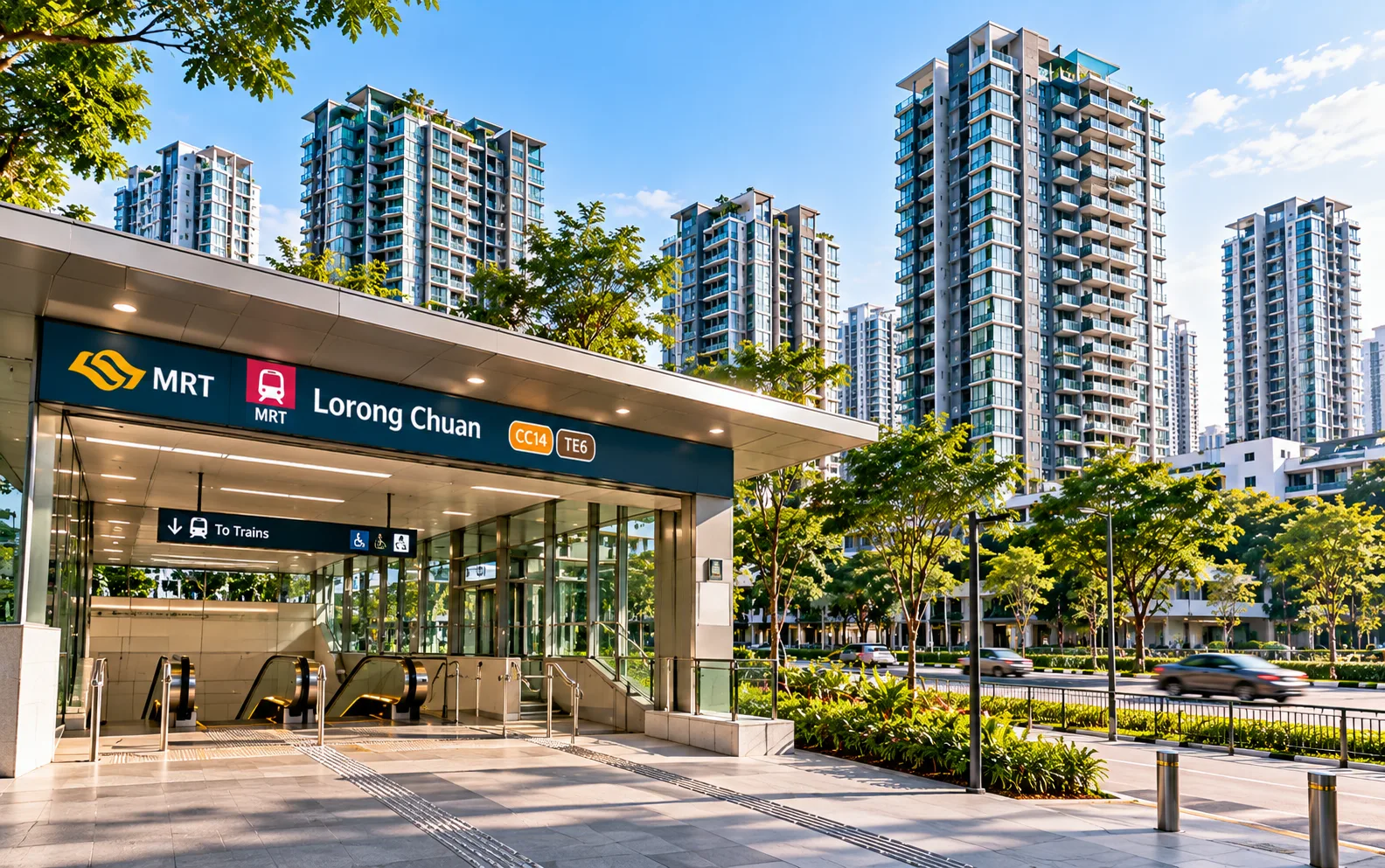
Buying a property near an MRT station has long been an important consideration for Singapore homeowners and investors. Convenient public transport can improve accessibility, shorten commuting times and make a location more attractive to potential buyers and tenants.
But what happens when a property is purchased near a future MRT station before the station location is officially announced?
That question became a major public issue in September 2026, after an academic working paper examined whether public officers involved in rail planning had disproportionately purchased private properties near locations that subsequently became MRT stations. The findings prompted a government review, followed by a parliamentary update on 6 October 2026.
According to the Public Service Division (PSD), 191 public officers’ property transactions were reviewed. Eight cases were referred to the police for further examination. The checks were still ongoing at the time of the announcement. A referral does not establish that an individual committed misconduct. Source: Channel NewsAsia, 6 October 2026.
For ordinary property buyers, the story raises several practical questions. How much should an anticipated MRT station influence a purchase? Can buyers reasonably invest based on public planning signals? What information should they verify before committing to a property?
The key lesson is not to avoid properties near future transport infrastructure. It is to understand the difference between publicly available information, speculation and confidential information—and to evaluate a property on its merits rather than rely on a single anticipated development.
What Happened in Singapore in 2026?
The academic paper that triggered the review
In September 2026, a working paper published by the US-based National Bureau of Economic Research (NBER) examined property transactions involving Singapore public officers and their proximity to MRT stations announced at a later date.
The researchers examined historical property purchases and compared the behaviour of identified public officers with a control group. Their paper reported that public officers were more likely than the comparison group to purchase properties near future MRT stations one to two years before the station locations were publicly announced. The authors interpreted the statistical pattern as consistent with informed purchasing.
However, a statistical association does not, on its own, establish that a particular person accessed confidential information, acted on it or breached any rule. The findings were based on historical data and a research methodology that became part of the public discussion.
The distinction is important because properties can be purchased for many legitimate reasons. Buyers may already live in an area, work nearby, prefer a particular neighbourhood or independently assess publicly available planning information.
The NBER research paper and the subsequent government response should therefore be read as separate pieces of evidence: one presents an academic analysis of historical transactions, while the other addresses whether the findings indicate actual misconduct requiring further examination.
What did the government review?
On 14 September 2026, PSD said it was reviewing the paper’s data and methodology. On 25 September, it announced that it was identifying property purchases made by officers involved in rail planning, focusing on the historical period highlighted by the research.
The scope was extended to transactions between 2007 and 2014 as a precaution, because relevant MRT station locations continued to be announced after 2011.
On 6 October 2026, Coordinating Minister for Public Services Chan Chun Sing told Parliament that PSD had reviewed 191 public officers’ transactions. Eight cases were referred to the police because their circumstances warranted further examination or because there was insufficient information to exclude them from the review.
The government also said further checks were continuing and that it would study what the review revealed about gaps in existing safeguards. Source: PSD parliamentary reply, 6 October 2026.
These details matter because the case concerns the potential use of non-public government information by people whose work may have given them access to sensitive planning information. It is not a general finding that buying property near a future MRT station is suspicious or improper.
Why Can Future MRT Stations Affect Property Values?
Transport connectivity is a recognised factor in residential property decisions. A station can change how convenient a location is for residents, employees and visitors, potentially affecting demand.
However, the effect is not automatic, immediate or identical across all properties.
1. Better accessibility can improve a property's appeal
A home within convenient walking distance of an MRT station may offer practical benefits to residents who commute regularly or prefer not to depend on a car.
Accessibility can also matter to tenants. A property with convenient access to employment centres, schools, shopping areas and other amenities may appeal to a broader pool of prospective tenants.
These benefits can influence how buyers compare properties in different locations. But the premium associated with transport access depends on the actual journey, alternative transport options, neighbourhood facilities and the property itself.
An advertised distance to a station is not always the same as a convenient walking route. Buyers should examine pedestrian access, road crossings, sheltered walkways and the likely route to the station entrance.
2. Anticipated infrastructure can influence expectations before completion
Property markets often respond to expectations about future improvements before those improvements become operational.
When a transport project is officially announced, buyers may begin considering how the completed infrastructure could affect commuting convenience and neighbourhood demand. Sellers may also adjust their expectations.
This does not mean every announced project produces a corresponding increase in property prices. Buyers may already have anticipated the improvement, the project may take years to complete, or other market factors may offset its benefits.
A property purchased before an announcement may also perform poorly if the buyer overpays, the expected infrastructure is delayed, or broader market conditions deteriorate.
For this reason, anticipated transport connectivity should be treated as one factor in a property assessment—not as a guarantee of capital appreciation.
3. The market may already price in public information
Not every insight about a future transport corridor requires access to confidential information. Government planning documents, publicly announced transport projects, existing land-use plans and visible development activity can all help buyers understand how an area might evolve.
However, interpreting these signals requires care. A broad planning direction does not necessarily confirm the exact location, timing or design of a future MRT station.
A buyer should distinguish between an officially announced station, a transport project under public consultation, a broad planning possibility and an unverified market rumour.
The further a property decision depends on an unconfirmed assumption, the more uncertainty the buyer is accepting.
What Should Property Buyers Learn from the Case?
Lesson 1: Separate confirmed information from speculation
Before buying a property partly because of future transport infrastructure, establish what is actually known.
Check whether the station has been officially announced, whether the location is confirmed, what the published project timeline says and whether any significant details remain undecided.
Do not treat a sales agent’s statement, social media post or informal conversation as equivalent to an official announcement.
For a buyer, the practical question is simple: would this property still make sense if the expected station were delayed, redesigned or did not deliver the anticipated benefit?
If the answer is no, the investment may depend too heavily on an uncertain event.
Lesson 2: Do not pay an unverified future premium
A property's asking price may already reflect the seller's expectations about future infrastructure. Buyers should test those expectations against actual transaction evidence.
Compare the property with similar homes in the same development or neighbourhood. Consider differences in floor area, tenure, remaining lease, age, condition, layout and proximity to existing transport.
If a seller is asking for a substantial premium because a future MRT station is expected nearby, ask what evidence supports that premium. Is there an official announcement? Have comparable properties actually transacted at higher prices? Or is the proposed value based mainly on speculation?
A buyer should not assume that future infrastructure will compensate for an excessive purchase price.
The property market analysis guide can help readers think more systematically about market evidence, pricing and local conditions.
Lesson 3: Evaluate the property even without the MRT story
A strong property decision should make sense beyond a single infrastructure narrative.
Consider whether the property suits your housing needs, whether the price is reasonable compared with alternatives, and whether the location already offers adequate transport, amenities and access to work or family.
For an investment property, examine realistic rental demand, recurring expenses, financing costs, vacancy risk and your intended holding period. A potential MRT station may strengthen the case for a location, but it cannot replace the financial assessment.
A useful approach is to assess the property under two scenarios: one in which the anticipated transport improvement occurs as expected, and another in which it is delayed or has a smaller effect than anticipated.
If the purchase is only viable under the optimistic scenario, reconsider the risk.
Lesson 4: Keep records of the information used in your decision
Property purchases involve significant financial commitments. Buyers should retain records of the information they relied on, including official planning documents, transaction comparisons, valuation material and relevant correspondence.
Keeping a clear record can help buyers revisit their assumptions and understand why a particular property was selected.
This is especially useful when an investment thesis relies on several future developments, such as transport improvements, new commercial facilities or changes to the surrounding neighbourhood.
Record-keeping is not a substitute for professional advice, but it can make the decision process more transparent and disciplined.
Lesson 5: Understand the difference between legitimate research and confidential information
There is nothing inherently wrong with studying publicly available planning information before making a property purchase.
Buyers routinely assess infrastructure, population growth, new employment centres, future housing supply and neighbourhood improvements. Such research is part of ordinary property due diligence.
The concern in the 2026 review is different: whether individuals with access to non-public government information used that information for private financial benefit.
Ordinary buyers should not try to obtain confidential information through unofficial channels or rely on claims that someone has privileged access to future government decisions. Such claims may be unreliable, and acting on sensitive non-public information can create serious ethical or legal issues depending on the circumstances.
A disciplined investment process should be based on information that can be independently verified.
How Should Buyers Assess a Property Near an MRT Station?
A practical assessment should consider the current property, the transport infrastructure and the buyer's financial position together.
Step 1: Verify the station's status
Start with official information. Determine whether the station has been formally announced and whether the relevant location and project details are confirmed.
If the station is only rumoured or inferred from a broader planning document, label it as an uncertain possibility rather than a fact.
Step 2: Measure real-world accessibility
Check the actual route from the property to the station, including pedestrian access, road crossings and the location of entrances. Consider whether the route is practical in Singapore's weather and whether other transport options are available.
A property that is technically close to a station may not enjoy the same convenience as one with a direct, easy walking route.
Step 3: Compare actual transactions
Use comparable transactions to establish a realistic price range. Compare properties with similar characteristics and be cautious about using asking prices alone as evidence of market value.
If a property commands a premium, determine whether the premium is supported by current advantages, verified market evidence or merely a prediction about future infrastructure.
Step 4: Assess affordability and downside risk
Calculate the full purchase cost and assess whether the property remains financially manageable if prices do not rise as expected.
Buyers should consider their down payment, mortgage obligations, stamp duties, legal expenses, maintenance costs and other ownership expenses. They should also account for the possibility of delayed infrastructure, changing interest rates or a weaker resale market.
The property affordability guide provides a useful starting point for this exercise.
Step 5: Match the purchase to your time horizon
A homeowner planning to live in a property for many years may value transport convenience differently from an investor hoping to sell shortly after a station announcement.
Longer holding periods can give buyers more time to benefit from changes in a neighbourhood, but they do not eliminate risk. Shorter investment horizons may be especially vulnerable to transaction costs, market volatility and delays in infrastructure delivery.
The intended holding period should therefore be part of the purchase decision from the beginning.
What Does This Mean for Singapore's Property Market?
The review has brought attention to the relationship between government planning information and private property decisions. It has also raised broader questions about safeguards for individuals whose work gives them access to information that could affect land values.
However, the case should not be used to conclude that all properties near future MRT stations have been purchased improperly or that the wider property market is unreliable.
The review concerns historical transactions involving public officers whose roles may have given them access to non-public information. The government’s referrals for further examination are not findings of guilt, and the checks were ongoing as of the latest parliamentary update discussed here.
For the wider market, the enduring lesson is about information quality. Property values can respond to transport infrastructure and planning decisions, but buyers should be careful about how they distinguish confirmed developments from expectations.
This also matters when comparing the performance of different residential segments. Broader market trends, affordability, supply and buyer demand can influence prices independently of any one infrastructure project.
Readers can compare this issue with the wider trends covered in our analysis of the Singapore property market in Q3 2026.
A Responsible Approach to Infrastructure-Led Property Investment
For buyers, the best response to the MRT station controversy is not to abandon infrastructure-led analysis. Transport accessibility remains a reasonable factor to consider when choosing a home or investment property.
The key is to place that factor in the correct context.
First, distinguish official information from speculation. Second, compare the asking price with actual market evidence. Third, assess whether the property is financially sound without relying entirely on future appreciation. Finally, keep a clear record of the assumptions behind the decision.
A future MRT station may improve a property's appeal, but it cannot guarantee a profit or justify any asking price.
The 2026 review also highlights why buyers should be cautious about claims of insider knowledge. A confident prediction is not the same as verified information, and a property decision should not depend on promises that cannot be independently checked.
Ultimately, a good property purchase is one in which the location, price, affordability and intended use make sense together. Infrastructure can strengthen that case—but it should not be the entire case.
If you are considering buying, selling or investing in Singapore property, review your options carefully and seek advice tailored to your circumstances. You can explore James Kong Property's buying services or contact James Kong to discuss your property needs.
Want this applied to your own home move?
Every article here generalises. A 20-minute conversation makes it specific to your numbers.
Sources
- Public Service Division (PSD) — Reply to Parliamentary Questions on Government's Response to Academic Paper, 6 October 2026. www.psd.gov.sg/newsroom/reply-to-pqs-on-government-s-response-to-academic-paper/
- Channel NewsAsia (CNA) — 8 public officers referred to police after review of 191 property transactions near unannounced MRT stations, 6 October 2026, updated 9 October 2026. www.channelnewsasia.com/singapore/parliament-chan-chun-sing-psd-property-police-6435176
- Channel NewsAsia (CNA) — Government reviewing study alleging civil servants bought homes near unannounced MRT stations, 25 September 2026. www.channelnewsasia.com/singapore/private-properties-mrt-stations-rail-planning-officials-review-nber-paper-6410066
- National Bureau of Economic Research (NBER) — Do Social Norms Substitute for Enforcement? Evidence from Public Officials' Home Purchases in Singapore. www.nber.org/papers/w34259
- The Business Times — Buying homes near unannounced MRT stations: What informed the decision?, 17 September 2026. www.businesstimes.com.sg/opinion-features/buying-homes-near-unannounced-mrt-stations-what-informed-decision
Why are property purchases near unannounced MRT stations under scrutiny in Singapore?
How many public officers were referred to the police?
Does being referred to the police mean an officer is guilty?
Is it wrong for ordinary buyers to purchase property near a future MRT station?
Do properties near MRT stations always increase in value?
Should I pay more for a property near a planned MRT station?
How can I verify whether an MRT station has been officially announced?
What are the main risks of buying property based on future infrastructure?
Is publicly available planning information useful for property investment?
What should I do before buying a property near a future MRT station?

Written by
James Kong (CEA R071529F)
Marketing Director at ERA Realty Network and Certified Aspiration Strategist, helping Singapore families plan their HDB and condo moves.