
Singapore Property Outlook for the Rest of 2026: Prices, New Launches and Key Risks to Watch
Singapore’s property market enters the final months of 2026 with private home prices rising, HDB resale prices easing and a substantial pipeline of new housing supply ahead. Here is what buyers, sellers and homeowners should monitor, from upcoming condo launches and BTO flats to affordability, interest rates and the risks of making decisions based on short-term market movements.
Singapore’s residential property market is approaching the final stretch of 2026 with several different trends unfolding at the same time.
Private residential property prices strengthened in the third quarter, while HDB resale prices declined for the third consecutive quarter. New condominium launches continue to attract attention, the Government is maintaining a substantial pipeline of private housing supply, and another major HDB BTO exercise is scheduled for November.
For homeowners and prospective buyers, these developments create both opportunities and uncertainties. Buyers may have more choices as new projects enter the market, but affordability remains important. Sellers may still achieve attractive prices for well-positioned properties, although broad market indices do not guarantee the value of an individual home. Investors must also consider financing costs, rental demand, future supply and the possibility that market conditions could change.
The most useful way to approach the rest of 2026 is not to assume that property prices will rise or fall uniformly. Instead, understand what the latest official figures show, identify the factors that could influence the next few months and evaluate each property against your own financial circumstances.
This article uses information available as of 21 October 2026. The URA’s full Q3 2026 real estate statistics are scheduled for release on 23 October, so the Q3 private residential figures discussed below are flash estimates and should be updated when the final data become available.
1. Singapore Property Market in Q3 2026: What Do the Latest Numbers Show?
The third-quarter flash estimates reveal a clear divergence between private residential and HDB resale prices.
According to the Urban Redevelopment Authority (URA), the overall private residential property price index increased by 1.4% quarter-on-quarter in Q3 2026, compared with a 0.5% increase in Q2. The Housing & Development Board (HDB), meanwhile, reported a 0.2% decline in its Resale Price Index.
Market indicator | Q3 2026 flash estimate | What it suggests |
|---|---|---|
Overall private residential prices | +1.4% | Price growth accelerated |
Non-landed private residential prices | +0.9% | Prices increased overall |
Landed residential prices | +2.8% | Stronger quarterly growth |
Non-landed prices in the Core Central Region | -0.1% | Slight decline |
Non-landed prices in the Rest of Central Region | +0.2% | Broadly flat movement |
Non-landed prices in the Outside Central Region | +2.2% | Stronger regional growth |
HDB Resale Price Index | -0.2% | Third consecutive quarterly decline |
Sources: URA and HDB Q3 2026 flash estimates.
These figures illustrate why it is misleading to describe the entire housing market as either booming or weakening. Private property prices increased overall, but the rate of change differed by property type and location. HDB resale prices declined modestly, while transaction activity remained meaningful.
The URA also reported that private residential sale transaction volume, based on information available up to mid-September, was approximately 30% lower quarter-on-quarter. The lower volume is an important counterpoint to the price increase: fewer transactions took place during the period covered by the flash estimate, even as the overall index rose.
For the official figures, refer to the URA Q3 2026 flash estimate and the HDB Q3 2026 resale price announcement.
2. Will Private Property Prices Continue Rising in Q4 2026?
Private residential prices enter the final quarter of 2026 after a stronger Q3. However, one quarter of faster growth is not enough to establish that prices will continue increasing at the same pace.
Several factors deserve attention.
Regional performance will matter
The Q3 results were uneven. Landed property prices increased by 2.8%, while non-landed prices in the OCR rose by 2.2%. The RCR recorded a smaller increase of 0.2%, and the CCR saw a 0.1% decline.
These differences suggest that buyers should focus on the particular location and property type they are considering rather than apply the national index to every home.
A suburban condominium, for example, may compete with different projects and appeal to a different group of buyers than a prime central development. Landed properties also have distinct supply characteristics and buyer considerations.
The next quarter’s performance will depend on actual demand, the mix of properties transacted, new launch pricing and broader economic conditions.
New launches may influence buyer activity
The private residential market has seen changing levels of launch activity throughout 2026. A broader pipeline of projects entering the market could give buyers more choice in the final months of the year.
More launches do not automatically mean lower prices. Developers must consider land costs, construction expenses, financing, competing projects and their sales strategies. Buyers, meanwhile, may compare new developments with resale condominiums offering immediate occupation or different locations and layouts.
The more useful question is whether a particular project is competitively priced relative to comparable alternatives.
For buyers considering a new launch, compare the unit’s total purchase price, layout efficiency, facilities, location and expected completion timeline. Do not assume that a new development will automatically appreciate because it is newly launched.
For a closer look at recent activity, read New Condo Sales Rebound in September 2026: Why Sales Nearly Doubled from August.
The final Q3 data release could change the picture
The Q3 figures available on 21 October are flash estimates, not the final statistics. URA is scheduled to release the full Q3 real estate statistics on 23 October 2026.
The final figures may revise the overall index, regional results or other indicators. Buyers and sellers making decisions based on quarterly data should review the updated figures instead of relying indefinitely on the initial estimate.
3. HDB Resale Market: Will Prices Stabilise?
The HDB resale market has experienced three consecutive quarterly declines in its price index. The flash estimate fell by 0.1% in Q1, 0.3% in Q2 and 0.2% in Q3 2026.
This pattern suggests that price growth has moderated, but it does not establish that prices will continue declining in the final quarter.
Transaction activity remains important
As of 29 September, HDB had recorded 7,528 resale transactions in Q3, 5.2% more than the 7,157 transactions recorded over the corresponding period in 2025.
This distinction between prices and volume matters. A market can record more transactions while its price index declines modestly. Buyers may still need homes, while sellers may be adjusting expectations to meet current demand.
The relevant question for individual buyers and sellers is not simply whether the index is falling. It is whether comparable flats in the specific town, flat type and price range are attracting offers and completing transactions.
Future resale supply may affect competition
HDB has pointed to the larger number of new flats expected to enter the resale market after meeting their Minimum Occupation Period over the coming years.
The effect will not be uniform. The location, flat type, remaining lease and characteristics of these flats will determine how directly they compete with existing resale homes.
Some resale flats may continue to appeal to buyers who need a home sooner or prefer a particular mature estate. Others may face greater competition from new or newly eligible resale alternatives.
For buyers, it is worth comparing the cost and waiting time of a resale flat with the alternatives available to them. For sellers, it reinforces the importance of understanding current competition and pricing the property realistically.
See the resale HDB buying guide for more on the purchase process.
Policy changes should be monitored, not overinterpreted
On 28 July 2026, the 15-month wait-out period was removed for private residential property owners and former owners buying eligible non-subsidised HDB resale flats, subject to applicable conditions.
HDB’s Q3 flash estimate stated that it had not observed a significant increase in the prices and number of resale flats purchased by these groups following the change.
This is a useful reminder that policy changes do not necessarily produce immediate, large movements in market prices. The impact depends on how many households are affected, whether they choose to act and the supply of homes that meet their requirements.
4. New Condo Launches: More Choice, but Not Every Project Is Equal
New condominium launches are likely to remain an important feature of the property market during the final months of 2026. A broader launch pipeline can provide buyers with more opportunities to compare locations, layouts and price points.
However, the presence of more projects does not mean every development will sell at the same pace or achieve similar prices.
Compare the full value proposition
When evaluating a new launch, buyers should consider:
Location: Access to public transport, workplaces, schools, shops and daily amenities.
Price: Total purchase price and price per square foot relative to comparable developments.
Layout: Usable space, room dimensions, storage and suitability for the intended household.
Development features: Facilities, unit mix, maintenance considerations and the overall design.
Completion timeline: Whether the expected completion date suits the buyer’s housing plans.
Competition: Nearby new launches, resale condominiums and other homes that target similar buyers.
Financial resilience: Whether the purchase remains affordable if income or interest rates change.
A project may have attractive facilities but still be unsuitable if its price stretches the buyer’s finances. Conversely, a development with fewer headline features may offer a more appropriate combination of location, layout and price.
Launch-weekend interest is not the same as long-term performance
Media coverage of a launch may focus on the number of units sold during the first weekend or the average price achieved. These figures can provide useful information about initial demand, but they do not guarantee future appreciation.
Buyers should distinguish between units released for sale, units sold, the total number of units in a development and the price measures used in reports. They should also examine the surrounding market and the remaining inventory.
A property should be purchased because its features, price and financial commitments make sense—not simply because a launch appears popular.
For a project-specific example, see Amberwood at Holland Launches in September 2026: What Its Sales Tell Us About Singapore Condo Buyers.
5. Housing Supply: Could More Homes Moderate Prices?
Housing supply will remain one of the key themes to monitor beyond 2026.
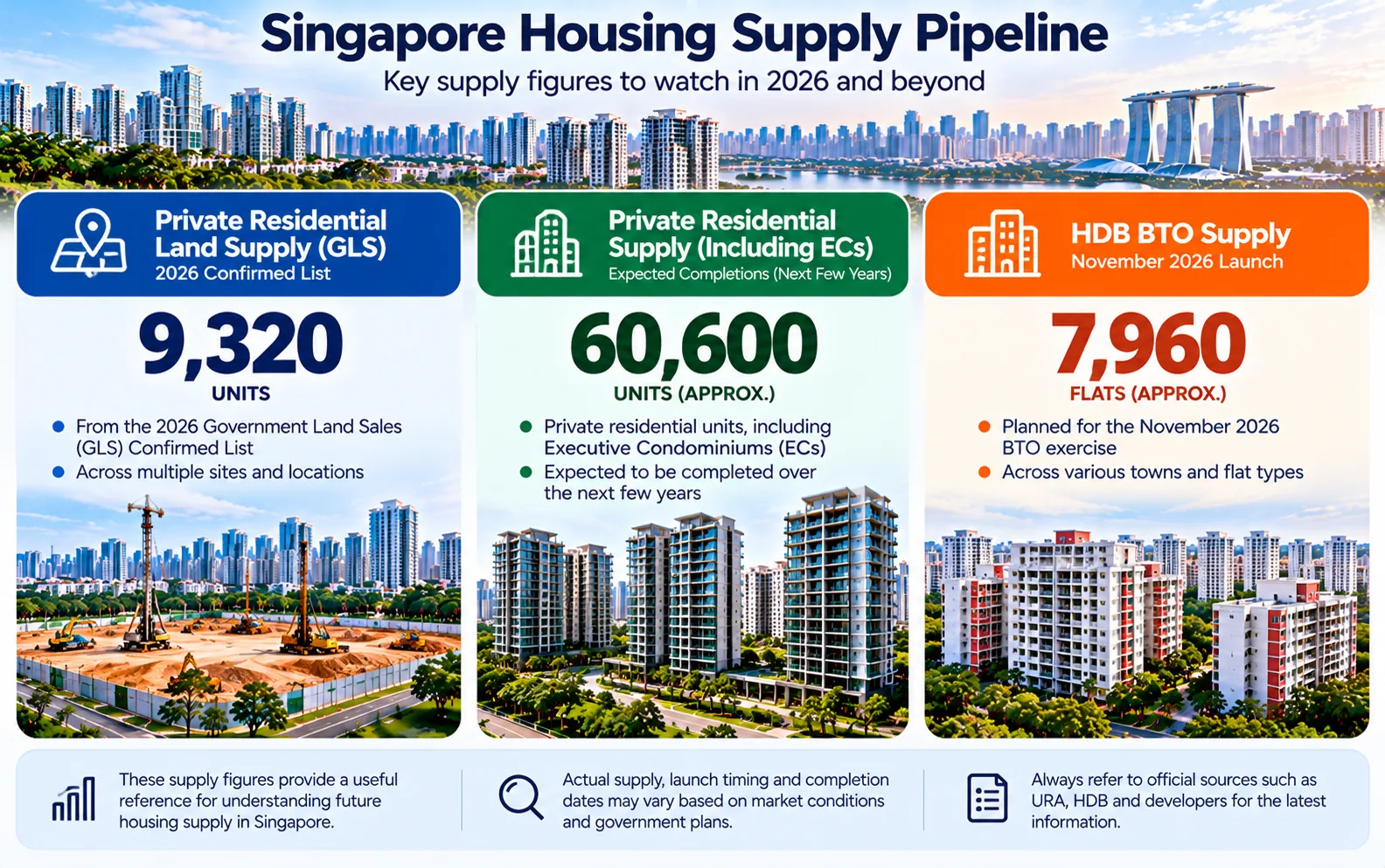
The Government is maintaining a high level of private residential land supply through the Government Land Sales (GLS) Programme. According to URA’s Q3 flash estimate announcement, the 2H 2026 Confirmed List will provide 4,745 private residential units, bringing the full-year Confirmed List supply to 9,320 units.
The full-year figure is more than 50% above the annual average over the preceding ten years. Around 60,600 private residential units, including Executive Condominiums, are expected to be completed over the next few years.
This pipeline can give buyers more options, but it should not be interpreted as a direct forecast of lower prices.
Supply takes time to reach buyers
Land sales, construction, project launches and eventual completion occur over different timeframes. A site being offered for sale does not mean completed homes will be available immediately.
The location of the supply matters too. A new development in one region may not be a close substitute for a property in another neighbourhood. Unit types, price ranges and target buyers also influence how much competition a new project creates.
More supply can improve buyer choice
A larger pipeline can help reduce the risk of a market in which too few new homes are available to meet demand. It may also give buyers more opportunities to compare projects and negotiate based on alternatives.
At the same time, developers must consider the cost of land, construction and financing when determining launch prices. The eventual outcome will depend on the balance between supply and demand, not on supply figures alone.
Buyers should assess actual projects and comparable transactions rather than assume that a high land supply figure guarantees a particular price movement.
For further context, read Singapore’s New Residential Land Supply: What the Latest GLS Sites Could Mean for Future Condo Prices.
6. November 2026 BTO Launch: What Should HDB Buyers Prepare For?
HDB has announced plans to launch approximately 7,960 BTO flats in November 2026 across Bedok, Geylang, Sembawang, Tengah, Toa Payoh and Yishun. Community Care Apartments will also be offered in Toa Payoh.
The launch is relevant to buyers who qualify for a new flat and can accommodate the applicable waiting period. It may also influence how eligible households compare BTO and resale options.
Check eligibility before applying
Buyers should ensure they have a valid HDB Flat Eligibility (HFE) letter when submitting an application. The letter informs applicants about their eligibility to buy a new or resale flat, CPF housing grants and an HDB housing loan, including the relevant amounts.
Because the November exercise is approaching, prospective applicants should check their application status and follow the latest instructions from HDB. They should not assume that eligibility, flat availability or pricing will be identical across all locations.
Compare waiting time and immediate housing needs
A BTO flat may suit households that can wait for a new home and meet the relevant eligibility requirements. An HDB resale flat may be more appropriate for someone who needs to move sooner or has specific location requirements.
Neither option is automatically better. The right choice depends on eligibility, total cost, location, household circumstances and timing.
The announcement of a BTO launch should also not be treated as proof that resale prices will fall in every area. The relationship between new supply and resale prices depends on the locations and flat types involved, as well as buyer preferences.
7. Interest Rates and Affordability: Risks Buyers Should Not Ignore
Housing affordability remains a major consideration for the rest of 2026. Both URA and HDB have highlighted uncertainty in the macroeconomic outlook, including global and domestic interest rates, and advised households to exercise prudence when purchasing property and taking out mortgage loans.
Even when prices appear attractive, the cost of borrowing can materially affect a household’s budget.
Stress-test the mortgage
Buyers should calculate repayments under more than one interest-rate scenario. A mortgage that appears manageable at the current rate may become more burdensome if the rate rises or if household income changes.
A prudent assessment should include other commitments such as existing loans, childcare, family expenses, insurance, maintenance fees and likely future costs.
Account for the full purchase cost
The purchase price is only one part of the financial commitment. Buyers may also need to account for stamp duties, legal fees, renovation, moving costs and ongoing maintenance.
Depending on the buyer’s profile and property type, additional eligibility rules, taxes or financing restrictions may apply. Buyers should confirm the rules that apply to their own circumstances before committing.
Keep financial flexibility
A property purchase can reduce the cash available for emergencies or other life changes. Buyers should avoid stretching their budget so far that they have little flexibility if employment, family circumstances or interest rates change.
For a structured starting point, refer to the property affordability guide.
8. Key Risks to Watch in the Final Months of 2026
Several risks could influence the market between now and year-end.
Risk 1: Overreacting to one quarter of data
A quarterly price increase or decline does not establish a long-term trend. Buyers should consider several periods of data, transaction volumes and the performance of the specific segment they are considering.
Risk 2: Assuming every location will perform alike
The Q3 regional figures show that private residential price movements differed by area. A national average cannot tell buyers exactly how a particular development or HDB town will perform.
Risk 3: Paying too much for future potential
Buyers may be attracted by anticipated infrastructure, new amenities or expected neighbourhood improvements. Such factors can be relevant, but the purchase price should be supported by evidence rather than assumptions alone.
Risk 4: Underestimating the effect of supply
New launches, future completions and flats entering the resale market can create additional choices for buyers. The impact varies by location and property type, so buyers should monitor the alternatives that directly compete with the property they want.
Risk 5: Taking on excessive financial commitments
A property that depends on optimistic assumptions about prices, rental income or interest rates can expose its owner to unnecessary risk. Buyers should assess whether they can manage the purchase if conditions are less favourable than expected.
Risk 6: Confusing market activity with guaranteed returns
A popular launch, a high transaction count or a rising index does not guarantee that an individual property will generate a profit. Purchase price, holding period, transaction costs and the eventual resale market all matter.
9. What Should Buyers and Sellers Do Before the End of 2026?
The right response depends on your position in the market.
If you are buying your first property
Start with eligibility, affordability and location. Decide whether a new launch, HDB resale flat or another eligible housing option best meets your needs.
Shortlist properties based on practical requirements before comparing prices. Use actual transactions where available and avoid committing solely because of a market headline or a sales promotion.
If you are upgrading from an HDB flat to private property
Assess the full financial sequence: the likely sale proceeds from your existing flat, outstanding mortgage, CPF refund obligations where applicable, purchase costs for the next property and the timing of both transactions.
A rising private property index does not guarantee that the specific home you are selling will achieve a higher price. Likewise, a modest decline in the HDB index does not mean every resale flat is losing value at the same rate.
A realistic assessment of both sides of the move is more useful than trying to predict the market perfectly.
If you are selling a property
Review recent comparable transactions, current competing listings and the characteristics of your property. Set an asking price that reflects the market for your specific segment.
Consider your next housing arrangement and financial obligations before deciding on timing. If the sale is funding another purchase, plan for the sequence of transactions and any temporary accommodation requirements.
You can explore the HDB selling guide or condominium selling service for more information.
If you are investing in property
Assess realistic rental demand, recurring costs, vacancy risk, financing and the likely holding period. Do not assume that a broad market price increase will translate into the same result for your property.
Compare the investment with alternatives and consider how it would perform if prices remain flat or rental income is lower than expected. The ability to hold a property through an unfavourable period is an important part of managing risk.
10. Singapore Property Outlook for the Rest of 2026: A Balanced View
The evidence available as of 21 October 2026 points to a market with different conditions across residential segments, rather than one uniform direction.
Private residential prices rose by 1.4% in Q3 according to URA’s flash estimate. HDB resale prices fell by 0.2%, extending a three-quarter decline. Meanwhile, the Government is maintaining substantial future private housing supply, and HDB is preparing to offer approximately 7,960 BTO flats in November.
These developments provide useful context, but they do not determine exactly what will happen to prices in Q4. The final Q3 URA statistics, subsequent transaction data, new launch activity, housing supply and financing conditions will all help clarify the direction of the market.
For buyers, the priority should be to find a property that fits their needs and remains financially manageable under less favourable conditions. For sellers, the priority is to understand their specific segment and price the property based on evidence. For investors, the priority is to evaluate risk, cash flow and the holding period rather than rely on short-term price movements.
The strongest property decision is not necessarily the one made at the perfect moment in the market. It is the one supported by sound research, a realistic budget and a clear understanding of the risks.
If you are considering buying, selling, upgrading or right-sizing before the end of the year, review your options carefully and seek advice tailored to your circumstances. Explore James Kong Property’s buying services or selling services to understand the next steps.
Want this applied to your own home move?
Every article here generalises. A 20-minute conversation makes it specific to your numbers.
Sources
- Urban Redevelopment Authority (URA) — Release of flash estimate for 3rd Quarter 2026 private residential property price index, 1 October 2026. www.ura.gov.sg/news/media/pr26-69/
- Housing & Development Board (HDB) — Flash Estimate of 3rd Quarter 2026 Resale Price Index and Upcoming Flat Supply, 30 September 2026. www.hdb.gov.sg/hdb-pulse/news/2026/20261001-Flash-Estimate-of-3rd-Quarter-2026-Resale-Price-Index-and-Upcoming-Flat-Supply
- URA — Data Release Calendar, updated 4 September 2026. www.ura.gov.sg/property-data/data-release-calendar/
- URA — Release of 2nd Quarter 2026 real estate statistics, 24 July 2026. www.ura.gov.sg/news/media/pr26-57/
- ERA Singapore Property Research — 3Q 2026 URA Private Residential Report: Prices Continue Growing Despite Quieter Quarter for New Home Sales, 2 October 2026. www.era.com.sg/research-articles/3q-2026-ura-private-residential-report
- ERA Singapore Property Research — 3Q 2026 HDB Quarterly Report: HDB Resale Prices Continue Falling Even as Transactions Balloon After Lifting of 15-Month Wait Out Rule, 2 October 2026. www.era.com.sg/research-articles/3q-2026-hdb-quarterly-report-hdb
- CBRE Singapore — Commentary on the flash estimate of Q3 2026 private residential property price index, 1 October 2026. www.cbre.com.sg/press-releases/commentary-on-the-flash-estimate-of-q3-2026-private-residential-property-price-index
What is the Singapore property outlook for the rest of 2026?
Will Singapore private property prices continue to rise in Q4 2026?
Are HDB resale prices expected to keep falling?
How much did private property prices increase in Q3 2026?
Will more new condo launches make prices cheaper?
How many BTO flats will HDB launch in November 2026?
Is it better to buy a BTO flat or an HDB resale flat?
What are the biggest risks for Singapore property buyers in late 2026?
Should I wait for property prices to fall before buying?
Where can I find reliable Singapore property market information?

Written by
James Kong (CEA R071529F)
Marketing Director at ERA Realty Network and Certified Aspiration Strategist, helping Singapore families plan their HDB and condo moves.